
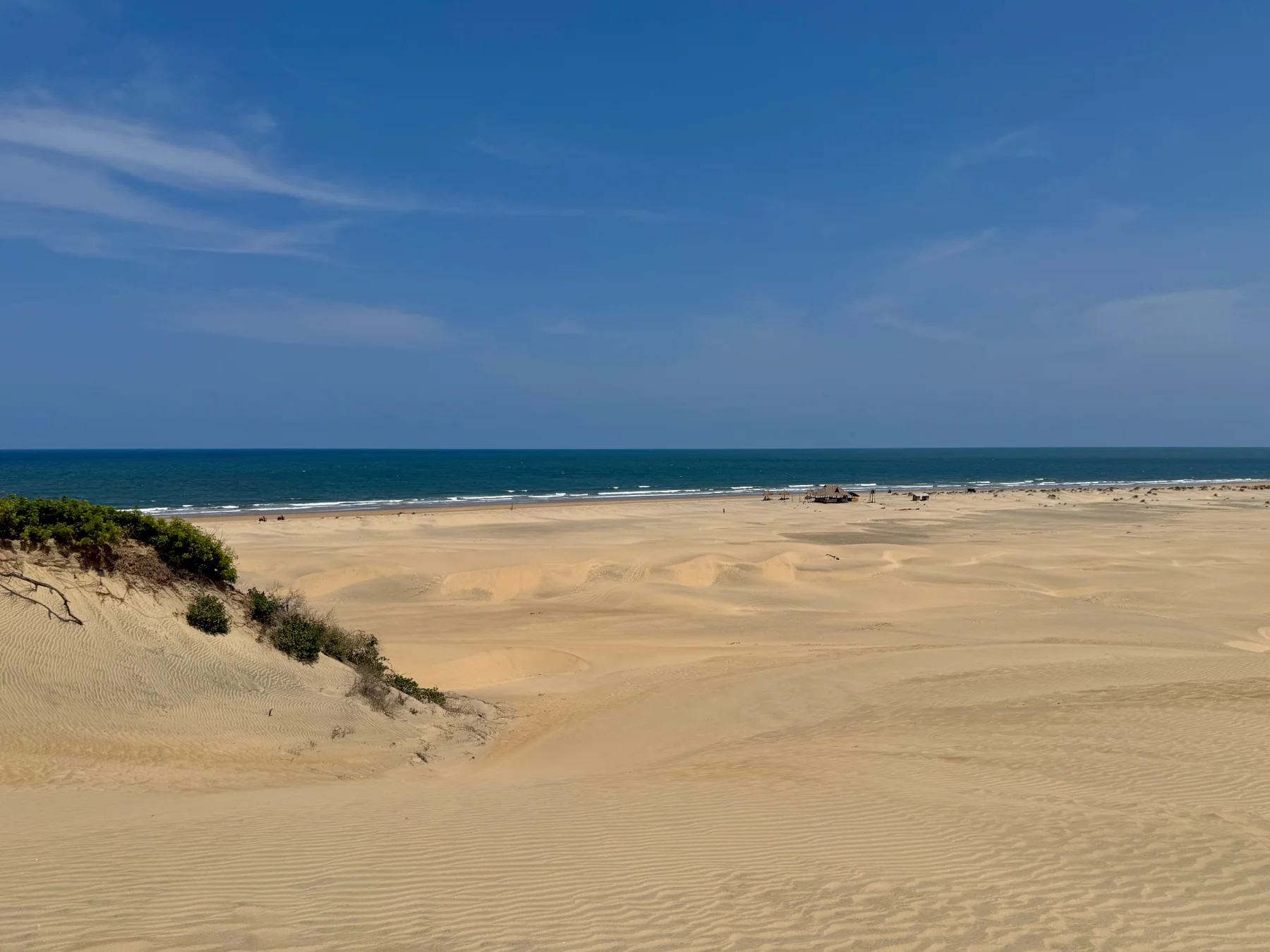

Mambrui is desert energy with an ocean soundtrack. Wind in your face, sand under your shoes, and waves. Lots of waves. Strong waves. You come expecting a beach day and end up somewhere between a dune field, a frontier outpost, a fishing coast, and a strange little corner of East Africa where old Italian voices drift through the heat and barefoot legends like Che Shale still hold their ground.
This is not polished postcard Kenya. Mambrui is rough around the edges, vast, rugged, and much more interesting because of it.
If you like your coast tidy, explained, and neatly packaged, Mambrui may not be your thing. If you like places with shrubs and bushes, strong winds, scorching sun, and a bit of dust in the teeth, now we are talking.
Most people know Mambrui for the sand dunes. They are dramatic, photogenic, and slightly unique in the best way. At moments, it barely looks like the Kenyan coast. More like desert, scrub, pale sand, and the Indian Ocean shoved into the same frame.
But Mambrui also has scale. Vast scale. You may think of it as “that place next to Malindi”, until you start moving around to explore the place. Then you realise that even on a quadbike, getting around the place takes time.
Quadbiking is not optional. It is the experience.
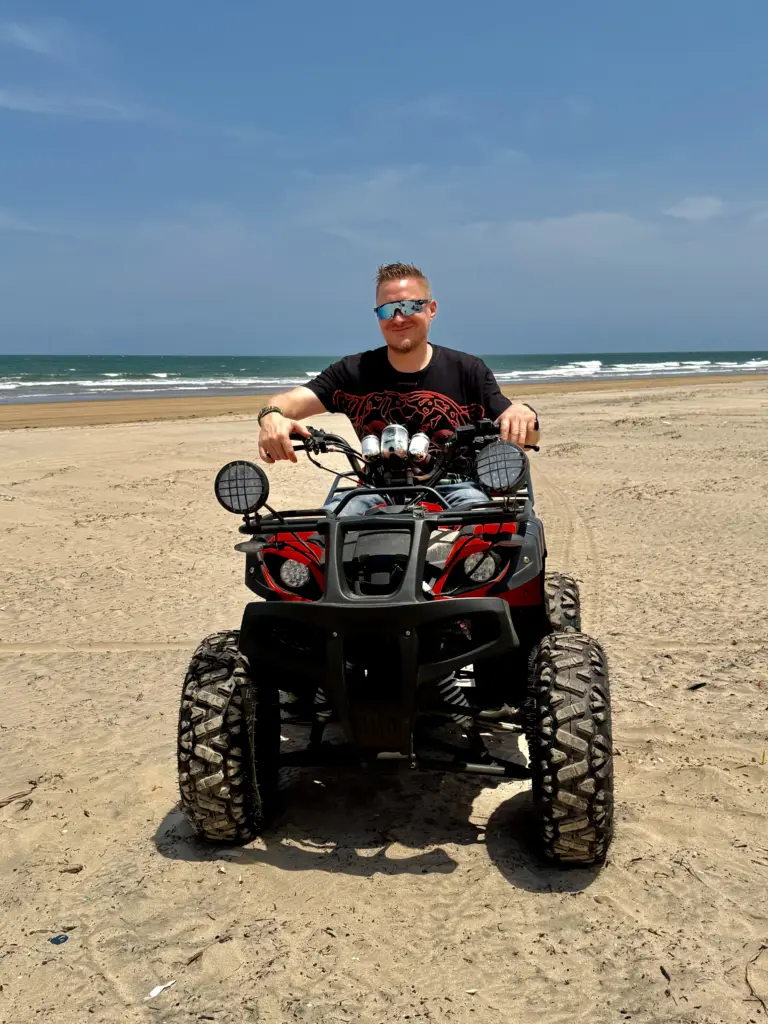
If you go to Mambrui and skip the quadbiking, you leave the main event on the table.
That said, not all quadbike rides are equal.
A lot of visitors do the short, obvious route, poke around the nearest dune section, take a few photos, throw some sand into the air for social media, and call it a day. The problem is that if you do that, you can easily end up in a small sandy valley with a dozen other visitors doing exactly the same thing. That version of Mambrui is fine. It is also the most watered-down version of the place.
The real experience starts when you push much further.
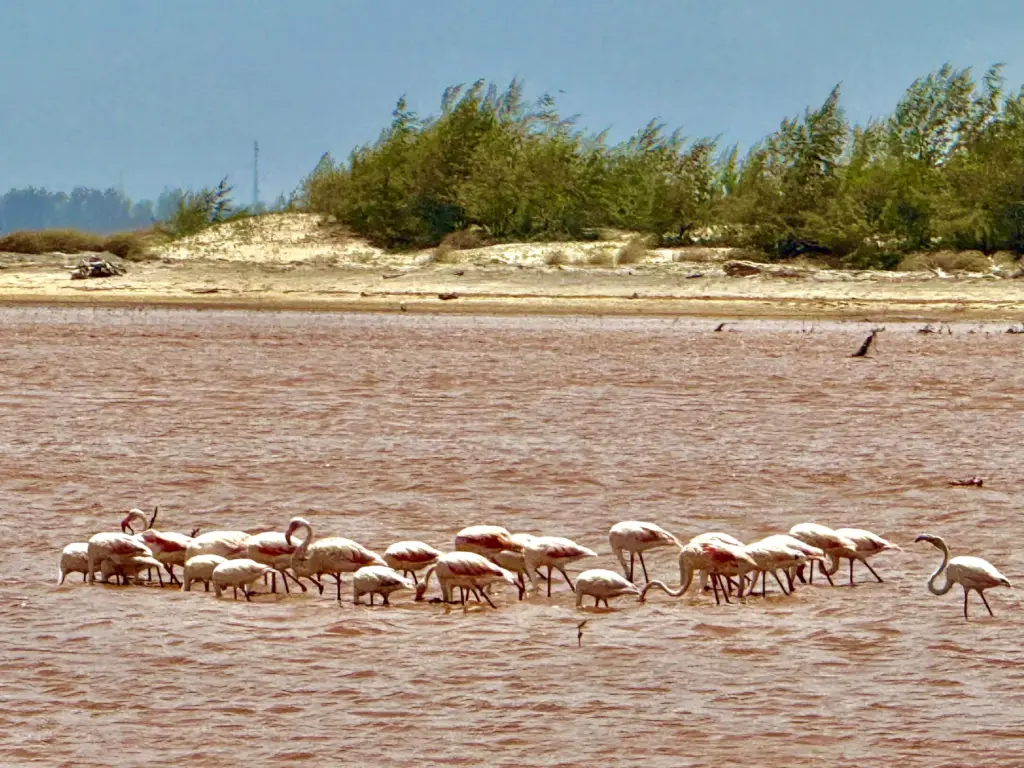
One direction takes you toward the Galana River Delta, where the whole landscape begins to feel bigger, emptier, and less staged. The meeting of river, beach, wetlands, and open sand gives that side of Mambrui a completely different mood. It feels less like an attraction and more like a territory. The water out there is magenta, almost crimson, like someone spilled dye into the shallows. And then you start noticing the life in it. Flamingos add that weird splash of elegance to the place.
There are hippos too, just in case someone needed the setting to feel even a little bit wilder and more untamed. The one hippo we saw was sleeping in the water, and I was told very clearly not to get close, which felt like excellent advice. Apparently there are crocodiles as well, but I missed out on that.
The other direction, toward Che Shale and on toward Ngomeni, is where the beach opens up into those vast, empty, wind-shaped spaces that make Mambrui feel properly cinematic. This is the side that gives you a new idea of just how wild the Kenyan coast can be (and this time not wild in the Mombasa nightlife sense!).
Not far from there sits the old Italian space centre near Malindi. Yes, an actual space centre in Africa, on the Kenyan coast. The kind of thing that should have a proper visitor centre, a small museum, a bit of storytelling, something. Instead, it mostly sits there closed off to tourists, like a piece of history nobody quite knows what to do with. Which is a shame, because a space centre in Africa should not be treated like some random side note.
Out there, the scale finally makes sense. The emptiness is the point. The ride stops being a tourist activity and starts feeling like movement through a landscape.
That’s the Mambrui worth going for.
Book a proper guide in advance
We had already booked a guide in advance. Someone I had actually met and spoken with, and discussed the experience in advance. That made the whole experience far better.
That’s not a small detail. It is one of the main practical tips I would give anyone going there.
Mambrui is one of those places where local hustlers can be quite aggressive, especially around the dunes and village access points. A few people will happily self-appoint as your guide before you have said yes, before you’ve asked a question, and some times before you’ve even switched off the engine. It can get tiring quite quickly.
A proper pre-arranged guide changes the whole tone of the visit. You move with purpose. You do not get dragged into endless mini-negotiations. You avoid confusion. You also stand a much better chance of actually reaching the best parts of the area instead of being parked at the most convenient photo stop and told that this is basically it.
Rahman, our guide, was waiting for us when we arrived. The three local guys trailing us since the parking lot had kept insisting on being our guides, so shaking them off was a relief. Rahman had been so excited to hear me speak Kiswahili the day before that I had to take one for the team. No English for me that day.
In a place like Mambrui, convenience is overrated. Guidance matters.
The dune fee confusion

The sand dunes are managed by a community organisation, which in principle makes sense. Places like this do need maintenance, local stewardship, and some structure if they are not going to be trashed by day-trippers and careless operators.
The problem is that the communication around it is not exactly world class.
What you may first hear can sound like somebody is asking you to pay to enter a public beach, which is obviously not the strongest opening line. What it actually seems to be is a maintenance fee for the dunes rather than some kind of beach access charge. That’s a big difference. It just isn’t always explained in a way that inspires confidence.
This is another reason to have a guide you trust. Let your guide handle it.
Mambrui is much more enjoyable when you are not trying to work out why someone is asking you to pay to enter what is supposedly a public beach, or pointing you toward some random building with no sign because that is apparently where the “sand dunes office” is.
The road north has a different mood
Part of the Mambrui experience starts before you even get to the dunes.
Once you head north out of the more familiar Malindi–Watamu–Kilifi rhythm and into that stretch beyond Kilifi County, the atmosphere changes. You feel it on the road. You see it in the terrain. You definitely notice it in the security presence.
On our drive in, there was a serious security check by what looked like an elite unit, presumably RECCE Squad or something similar. Not exactly your standard lazy roadside stop with someone half-looking into the back seat. It is the kind of checkpoint that reminds you this part of the coast used to be talked about as a “wild” stretch of Kenya, and not entirely without reason. Taking a picture may be tempting, but not advised.
That mood has not disappeared completely. Further up toward the Somalia border and the Boni Forest area, the risk picture is still a different story altogether. That part of Kenya remains sensitive, and no amount of optimistic holiday energy changes that – yet.
At the same time, this is also a region with massive infrastructure development going on. Roads have improved. Big transport and logistics ambitions are tied into the broader Lamu corridor. So you get this strange overlap of old insecurity narratives, hard security presence, and major state-backed infrastructure ambitions all sharing the same geography.
Kenya combines this better than most places: frontier mood, bureaucracy, armed checkpoints, and bold development plans in one continuous stretch of road.
Mambrui sits right in that tension. Not dangerous. Not exactly soft either. Just a place with more edge to it than the average beach destination brochure would know how to explain.
Che Shale is not just a hotel. It is part of the mythology.
You can’t really talk about Mambrui properly without talking about Che Shale.
Che Shale has been one of those names on the Kenya coast for decades. Not trendy-famous. Not influencer-famous. Proper famous. The kind of place people mention with a certain look, like they are half recommending it and half trying not to ruin it by talking too loudly.
That reputation did not appear out of nowhere.
Che Shale has real history behind it and has long held legendary status on this stretch of coast. It belongs to that old-school Kenya beach mythology of places that built their name before everything had to be turned into a brand deck and a drone reel. It has character.
And then there’s the seafood.
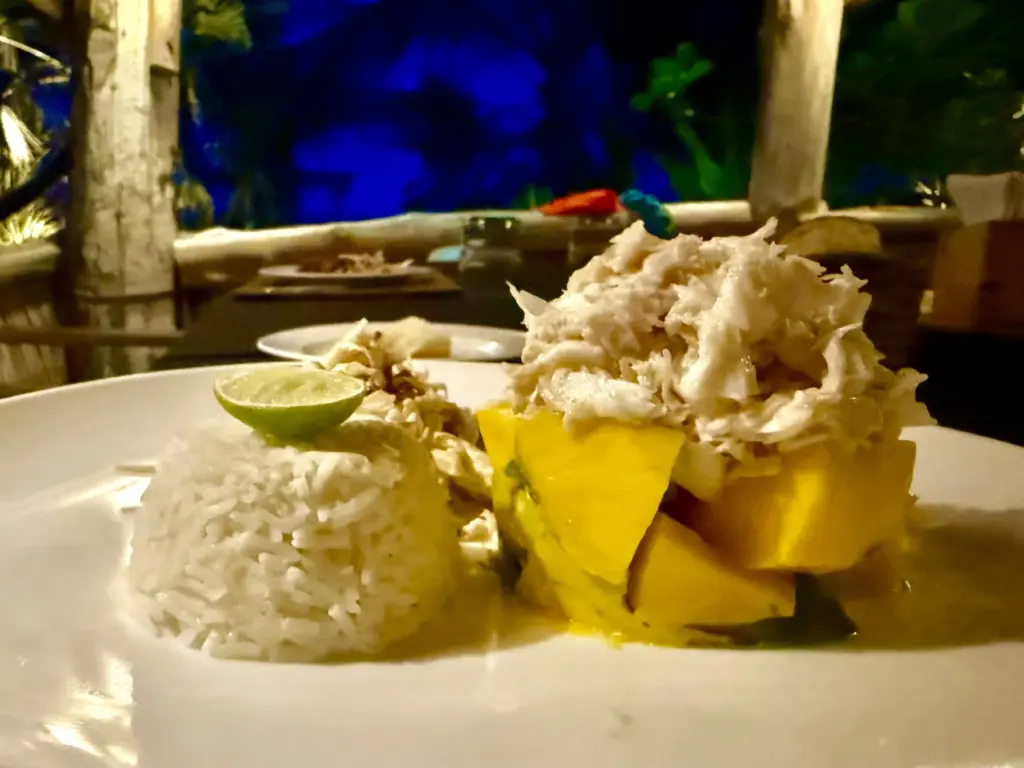
Che Shale is especially known for great seafood, and crabs are a big part of that story. Not in some over-engineered, fine-dining, tiny-portion kind of way. In the proper coastal way. Fresh seafood, serious flavour, sea breeze, sand nearby, and absolutely no need to overcomplicate the concept.
That fits the place perfectly. Mambrui is not somewhere you come for polished urban dining culture. You come here for sea air, appetite, and food that makes complete sense in its setting.
At Che Shale, crab is not just a menu item. It is part of the legend.
Little Italy, but older and slightly sunburnt
The Italian presence in this part of the coast is impossible to miss.
You hear it in the restaurants. You hear it in conversations. You hear it in the slightly surreal experience of being on the Kenyan coast and realising that half the ambient sound around you is Italian spoken by people who have clearly had no strong reason to improve their English over the last few decades.
This is not new. The Malindi area saw a major Italian tourism boom in the mid-to-late twentieth century, and that legacy is still all over the place. Around Mambrui and Malindi, there are many older Italians who have been coming for years, or staying for long periods, and the whole thing has a very particular feel to it.
The boom never really continued in the same way into a younger audience, so what you get today is a mainly older Italian presence rather than some constantly renewing wave of younger travellers. It gives the area a slightly frozen-in-time quality. Not dead. Not faded. Just still moving to the rhythm of a different era.
And honestly, that adds to the character.
Mambrui and the wider Malindi coast do not feel fully repackaged for the global lifestyle market. They still have some eccentricity. Some unevenness. Some personality. A bit of old-world coastal weirdness.
That is usually more interesting than perfection.
Hell’s Kitchen in Marafa is the bonus level
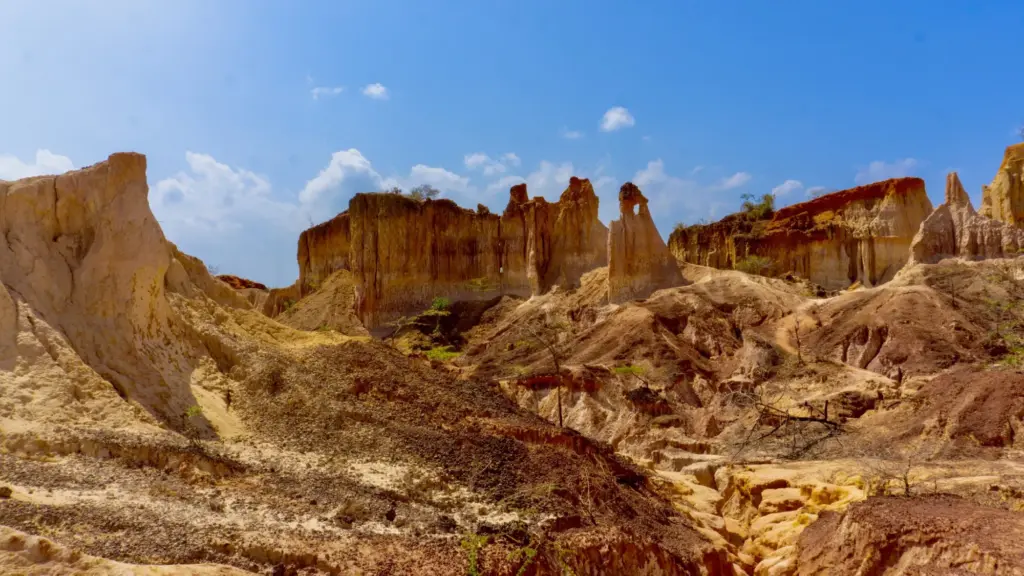
And if you want to turn the whole area into an even stranger and more brilliant landscape circuit, about 45 minutes inland you have Hell’s Kitchen in Marafa. Completely different terrain. Completely different mood. Red sandstone, jagged formations, heat bouncing off the rock, and a quick realization that you should have brought sunscreen and lots of water! The heat out there can be completely insane. Suffocating. Punishing. The perfect ingredients for a story narrated over a cold beer in the evening! Go early in the morning, or you are cooked. Literally.
Coast, dunes, river delta, badlands, and a space centre. Mambrui has it all.
This is a coast for people who like a bit of grit
Mambrui has wind, friction, confusion, scorching sun, empty space, beach politics, old enclaves, vague fees, and quadbikes tearing across the sand.
Mambrui still feels rough and real. Like potential tourism gem yet to be discovered.
Enjoy it while it lasts. Go before everyone else finds out about it!
Book a guide in advance. Let your guide deal with the local payment confusion around the dunes. Don’t settle for the short tourist loop on the quadbike. Ride further. Push toward the Galana River Delta or head north into the wider, emptier dune-and-beach country near Che Shale and Ngomeni. Eat seafood. Take in the oddness of the old Italian influence. Wonder why there is a space centre with no proper visitor experience. If you have the time, combine it with Hell’s Kitchen in Marafa and make a full day of enjoying one of the more unhinged landscape combinations in Kenya.
And if you feel that they could have done more to make it attractive for tourists, take a moment to enjoy the fact that it is the way it is. Off the beaten track. Not touristified. Not overly commercialized.
Because Mambrui is not your average tourist destination.
And that’s a big part of the charm.