
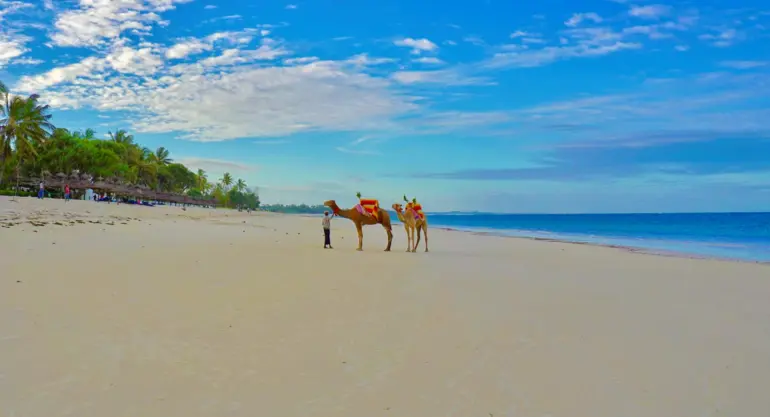
Diani is the centre of gravity of Kenya’s South Coast. If someone says “South Coast”, there is a good chance this is the place they mean.
It was already known before, of course, but Diani really started rising in the early 2000s as the next big thing in Kenyan beach tourism. Since then, the rise has been steady. Not a sudden boom, not some short-lived travel trend. Just year after year of more hotels, more restaurants, more investors, more attention, and more people realizing that this stretch of coast is genuinely hard to beat.


Diani has more than 17 kilometres of continuous beach, with wide, clean stretches of fine white sand and clear turquoise water. The sand is the soft, powdery kind that travel bloggers dream about. The “why did I carry these sandals?” kind of sand.
The water is warm, bright, and mostly crystalline turquoise. Or in other words: tempting. Even better, the sea urchin situation is far less annoying than in some other parts of the coast. A big plus if you enjoy walking into the ocean without looking like you are entering a minefield.
The beach is also usually impressively clean. That is one of the things that sets Diani apart. The beaches in places like Mombasa, Watamu, and Malindi can get a bit overwhelmed by seaweed at times. Diani tends to avoid the worst of that. It is not perfect every day, because beaches are beaches and the ocean is the ocean, but this stretch is unusually consistent.
Diani has repeatedly been voted the best beach in Africa by the World Travel Awards and other rankings. That keeps happening for a reason. To be real, travel awards can sometimes be a bit of a polite industry group hug, but for Diani, the reputation is deserved. Diani is not just good “for Kenya”. It is seriously good by any beach standard.
It also gives Zanzibar a proper run for the money. And I say that as someone who loves Zanzibar!
What You’ll Find Here
Diani – The South Coast’s Big Beach Name
Diani is not some hidden beach anymore. That ship sailed a while ago, probably with tourists on board and someone selling fresh coconuts nearby.
It is now one of Kenya’s most established beach destinations, and one of the fastest-growing. It shows. There are good hotels, some great restaurants, water sports, beach bars, cafés, villas, apartments, and enough services to make life easy without turning the place into a concrete resort strip. Yet.
That balance is part of the appeal. Diani is developed, but not completely swallowed by development. You can find luxury, comfort, and convenience, but you can still get long beach walks, quiet corners, and the kind of beach bliss that makes you stop pretending you are only here for “a quick break”.
The hotel scene has kept strengthening over the years. Older classics like Leopard Beach, Diani Reef, Southern Palms, and Baobab were built for the package-tourism era: large beachfront resorts designed for guests who could stay on the premises for two weeks without ever venturing outside.
I once tried that for a couple of days so you don’t have to. That was Kaskazi in 2007. Well, everything has to be tried at least once. Maybe.
The more recent additions, like Nomad, Almanara, and The Maji, tend to be more boutique and classier, with a more personal experience. My favourite, AfroChic by Elewana, sits squarely in that category: boutique, five-star, polished, personal, and outstanding in pretty much every way. Small luxury, but without the stiff nonsense that sometimes comes with it.
There are more hotels coming, unsurprisingly. Diani is now a hot investment destination. Land, villas, boutique hotels, serviced apartments, beach restaurants, short-stay rentals, and hospitality businesses are all part of the wider growth story here.
Wining and dining on the beach


Diani is also a very decent place for beach restaurants.
There’s the ever-famous Ali Barbours Cave Restaurant. Around since 1983, this is something of a legend on the Kenyan coast. The setting, in a natural cave under open skies is pretty magical. The food is decent too. For long, Ali Barbours ruled alone as the only cave restaurant in East Africa. It now has competitors in Mombasa and Watamu, and more will join the game for sure.
Other places worth mentioning in an increasingly crowded space are The Sails at Almanara, another personal favorite of mine. The Nomad Bar and Restaurant and Salty Squid are also well worth a visit.
I wrote a blog post about Diani’s beach restaurants back in 2020. Yes, that now needs an update. Time has moved on, and I clearly need to go back and do the difficult fieldwork of eating more seafood by the ocean. A momentous task, but someone has to carry that burden.
Calm, Easy, and Not Too Pushy
One of the good things about Diani is that it feels pretty calm, at least for a famous beach destination.
There are beach boys trying to sell you stuff, of course. This is the Kenyan coast, not a private island in a billionaire fantasy brochure. But in Diani, the pressure is generally manageable. Most of the time, a polite “no thanks” is enough. You can walk, swim, sit, read, eat, drink, and waste time properly without feeling constantly chased.
That makes a difference. A good beach destination is not only about sand and water. It is also about how easy it feels to be there. I give Diani a good score on that one.
There are also enough modern amenities around to make longer stays comfortable. There is a small mall, shops, supermarkets, ATMs, pharmacies, cafés, and even a Java House. So yes, if you need coffee, Wi-Fi, groceries, sunscreen, or a mildly guilty mall break from the beach, you are covered.
Tiwi – the Quieter Side North of Kongo River


If Diani is fairly calm, Tiwi is a different story altogether.
Located north of the Kongo River (not the one where the Grand Inga Dam has been planned for more than half a century), Tiwi is quieter, slower, and far less tourist-heavy. The beaches there feel more local, more peaceful, and more removed from the busier parts of Diani. There are fewer resorts, fewer visitors, and much less of the polished beach-destination machinery.
That peace is part of the attraction. Tiwi is the kind of place where you go when you want the coast without the noise. No big scene. No major nightlife. No constant movement. Just beach, tide, reef, trees, fishing boats, and a slower rhythm.
But that quiet will not last forever.
The South Coast is changing. Existing establishments are expanding. New investors are entering. There is still a lot of space, but space near a beautiful beach rarely stays empty once roads, airports, and demand start lining up.
The Dongo Kundu Bypass and the recent expansion of Ukunda Airport will accelerate that process further. Better access means more visitors, more investment, more development, and higher land pressure. That can bring good things: jobs, infrastructure, better services, more options. It can also slowly eat away at the quiet that made the place special in the first place.
So as more people discover Diani, I will probably keep moving further down the coast, poking around quieter corners, smaller villages, and beaches that still require a bit more effort. That is usually how it goes with me. Find the nice place, enjoy it, watch it become popular, then wander off looking for the next less obvious stretch.