


Addis Ababa, or Addis for short, rarely arrives one thing at a time. Altitude. Traffic. Incense. Construction dust. Sharp suits. Church walls. Coffee arriving in cups so small they look harmless right up until they hijack your evening. My first trip here was in 2004, for work rather than tourism, and that probably suited the city. I came back later the same year, this time to explore properly and to visit Axum as well. Those memories stayed with me.
Addis has never felt like a place that spends much energy trying to win you over on arrival. It has other business. I have been back many times since. Long enough to watch it grow, spread, densify, and turn into something much bigger and more intense. That is part of why I keep returning. Addis Ababa packs power, memory, ambition, argument, and ordinary daily chaos into a very small amount of space.
What You’ll Find Here
Start Above the City
If you want to get your bearings in Addis Ababa, it helps to begin above it. Entoto gives you the wider picture. The air is cooler, the city opens up below, and the scale of it all starts to register. This is also where Emperor Menelik II based himself before the capital shifted down the slopes. Addis Ababa did not just become a capital by accident and keep growing from there. It was shaped around power, empire, and deliberate state-building.
Menelik still hangs over the city in more ways than one. He helped unify what became modern Ethiopia and defeated Italy at Adwa, which is not exactly a side note. What sticks with me is the gap between the size of that legacy and the relative modesty of his place up on Entoto. Addis is good at that sort of contrast. Heavy history. No need to package it too neatly.
The same goes for Haile Selassie. Outside Ethiopia, he is often flattened into symbol or myth. Inside Ethiopia, and especially among younger Ethiopians, views are more mixed and more grounded. Addis Ababa has room for both. It does not seem especially interested in forcing its history into one tidy version.


A Capital Growing Fast
One of the clearest changes I have seen over the years is Bole. Back in 2004, much of it still felt open, with farmland, scattered plots, and far less pressure. Now it is one of the city’s main engines. Hotels, offices, restaurants, apartments, traffic, construction, and the general sense that Addis has no intention of standing still for anyone.
That growth brings energy, but it has also cost the city parts of itself. Older Addis Ababa has thinned out in places under the logic of redevelopment. Piassa in particular has lost a lot of the character people remember. That is the trade-off in fast-growing cities. Build hard enough and long enough, and sooner or later you start tearing into the very fabric that made the place feel like itself.
Still, Addis has not lost itself. Not fully. Enough remains in the street life, the rhythm, the visual collisions, and the general mood that it still feels unmistakably Addis. Old stone. New tower. Church wall. Construction site. Minibus. Incense. Coffee tray. Someone dressed like they have somewhere very important to be. Someone else carrying half a hardware store down the road. Somehow, it still reads as one city.


Mercato at Full Volume
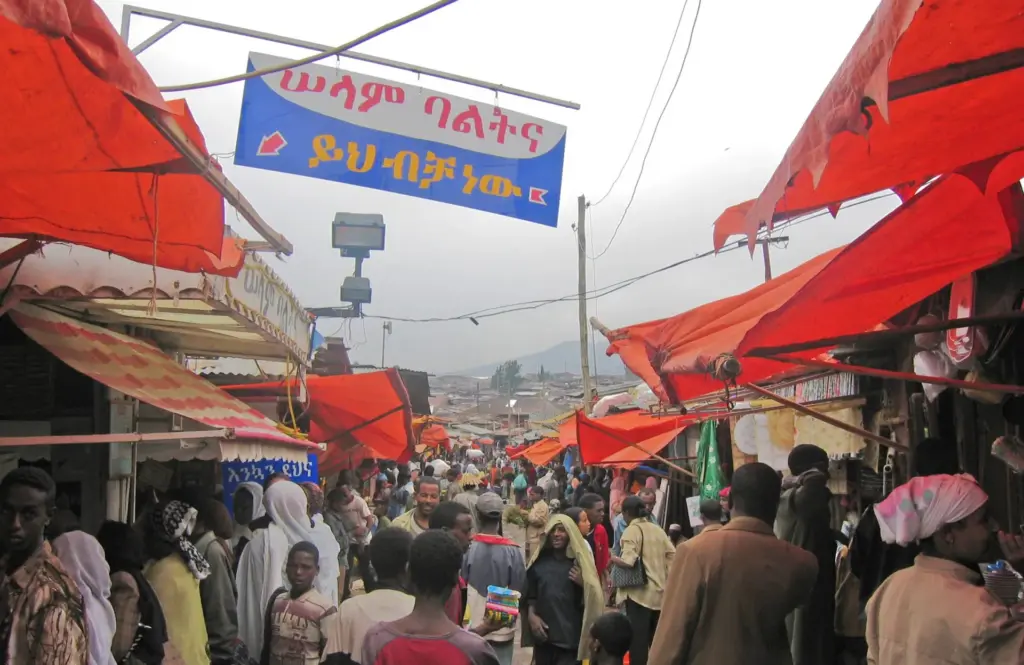
Then there is Mercato, which does not bother easing you in gently. It is often described as the largest open-air market in Africa. I have not gone around the continent with a measuring tape, but Mercato certainly feels large enough to make the point on its own.
This is Addis Ababa at full volume. Mud when it rains. Dust when it does not. Fabrics, spices, metal, smoke, shouting, movement, bargaining, hauling, weaving through gaps that barely count as gaps. It is one of those places where the city stops being abstract very quickly. You smell it before you finish seeing it. You hear it before you really understand where you are. And whatever calm, organized version of yourself you arrived with is no longer in charge.
I like places like that. You do not ease into them. You either tune in or get out of the way. Mercato is not dressed up for visitors. It is a working beast of a market, and that is exactly why it matters. If Addis has a pulse you can walk into, Mercato is a good place to find it.
Coffee, Food, and City Style
Addis Ababa feeds you properly. I cannot really pass through without grabbing a traditional meal, and I usually make sure at least one of them is at Yod Abyssinia or Habesha 2000. Both do the full thing properly. Traditional food, music, dance, atmosphere, and enough presence to remind you that dinner here does not need to be a quiet affair. Ethiopian food is one of those cuisines that tends to split people fairly quickly. Some are won over immediately. Others spend a few polite minutes wondering whether there might be a backup bread option somewhere nearby. I am very firmly in the first group.
A good spread with injera, doro wot, tibs, fish, lentils, vegetables, and sauces with real attitude is hard to beat. The good versions do not arrive quietly either. Ethiopian food has presence. So do the places built around it, especially when the meal comes with music, coffee, and a room that is fully leaning into the occasion rather than pretending not to.
Then there is the coffee. In Addis, coffee is not just something you have on the side. It helps structure the day. Ethiopia gave coffee to the world, and Addis behaves accordingly. Meetings, office visits, social calls, restaurants, homes, there is always a decent chance that before long someone will place a tiny cup in front of you. Strong coffee. Popcorn. Frankincense burning somewhere nearby. The whole thing calm and intense at the same time. It is one of the great everyday rituals anywhere on the continent. It is also a very efficient way to discover that your plans for an early night were fictional.
Traditional dress still feels alive in Addis, not boxed off for festivals and staged occasions. A lot of Ethiopian attire has a quiet elegance to it. Clean lines. Restraint. Confidence. No need to shout. The green, yellow, and red cotton shirts are a good example. Many people elsewhere connect those colours straight to Jamaica and Rastafarian imagery, but in Ethiopia they land differently. Older. Rooted. Fully at home. And yes, Addis is a very good place to buy one.


Where Diplomats, Bureaucrats, and Big Plans Gather
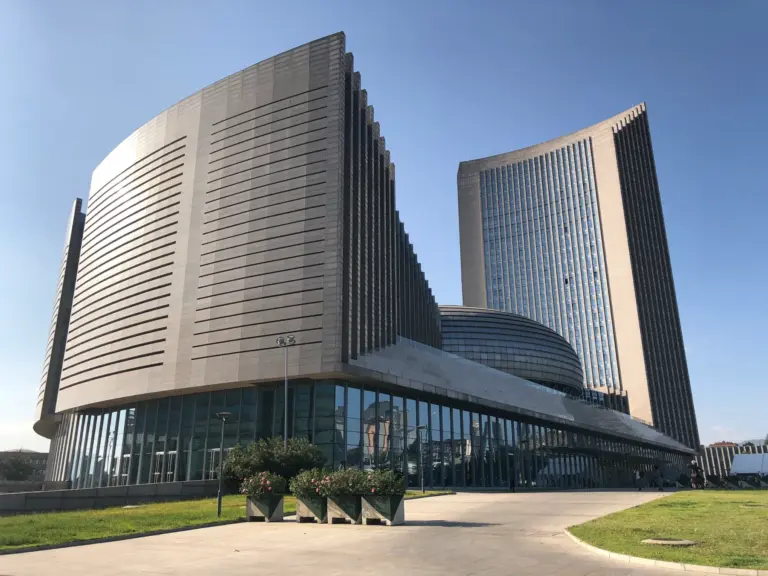
One of my strongest memories from Addis goes back to 2004, before the African Union headquarters rose over that part of the city. I remember walking up a narrow, winding, cobblestone-paved street on a small hill with trees and low ground-level buildings. We sat down at a small café and looked out over the giant construction pit downhill, where the future AU headquarters was taking shape. An older gentleman insisted we join his table, which we did. He did not speak English, but kept smiling and nodding as we sat there with our Ethiopian coffee served in tiny black clay cups, with incense in the air behind it all. I still remember that clearly. When I go back there today, I honestly have no idea where that hill even was. The only thing I can say for sure is that nothing in that area looks like it did back then.
That tells you quite a lot about Addis Ababa. It is a city that can remake whole sections of itself so completely that your own memory stops being much use.
Addis Ababa is not just Ethiopia’s capital. In a very real sense, it is one of Africa’s political capitals too. The African Union gives the city a different kind of weight. Not symbolic only. Functional. This is where presidents, ministers, diplomats, officials, advisers, and all the rest come to talk through the continent’s bigger questions, smaller arguments, endless paperwork, and the occasional serious moment of history.
That gives Addis a layer most capitals do not have. It is one thing to host government. It is another to host a continent talking to itself. Flags, protocol, convoys, statements, summit language, and all the theatre that comes with power. Addis has that. It can feel intensely local on one street and intensely geopolitical on the next.
I have always liked that contrast. You can go from traffic, coffee, and ordinary city noise to one of the main rooms where Africa tries to sort itself out. And yes, I have spoken there too, which is not a bad venue if you are going to address a room.


Why Addis Ababa Keeps Pulling Me Back
Addis Ababa is a complex city that comes in many layers. Proud. Contradictory. Historical. Ambitious. Sometimes chaotic. Usually over-caffeinated.
It is a city where imperial memory still matters, where Haile Selassie still divides opinion, where the Lion of Judah still carries real weight, where old neighbourhood character keeps losing ground and fighting back, and where Bole keeps charging ahead whether you are ready or not. It is also a city where you can eat extremely well, dress better than you planned to, drink coffee that completely rearranges your evening, and pass buildings where the politics of a continent are being argued through behind glass and security gates.
I have seen Addis Ababa across more than two decades now. Slower then. Bigger now. Sharper, denser, more vertical, more impatient. A lot has changed. Enough remains. That is why I keep coming back. A city that can mix empire, upheaval, diplomacy, daily chaos, and coffee this strong was always going to pull me back.
Bonus video: Late-night Ethiopian dinner at Yod Abyssinia
My last stopover in Addis Ababa was in Jun 2024, on the way back from my Namibia trip. Ethiopian Airlines have a particularly likable policy: if your layover is long enough, they put you up at the Ethiopian Skylight Hotel and arrange a short-term visa.
Yes, they do serve Ethiopian food there too, but no way! If I’m in Addis, even for a few hours, my first stop is either Yod Abyssinia, or Habesha 2000. Both are traditional Ethiopian cultural restaurants featuring music, dancers, and traditional attire from the different regions of the country. Both also serve Tej, the traditional Ethiopian honey wine, and have broader menus than most places.
This video is from that evening.